
Blog › In practice
In practiceWhy Excel is no longer enough for working-hours records
A spreadsheet was enough while work happened in the office and hours were added up at the end of the month. Ever since the Ordinance requires a daily record, at the source, Excel creates more problems than it solves. Here is why, and what to use instead.
Excel is not created at the source
The spreadsheet’s biggest problem is not its form, but the moment it is created. The Croatian Ordinance on working-hours records (NN 55/2024) requires the start and end of working hours for every day, yet in Excel that data is almost always entered afterwards, from memory or from paper. A record created a day or a week later is easily inaccurate.
No audit trail
In a spreadsheet anyone can change any cell, and without a trace. Such records hardly hold up for an inspection, and in a dispute the burden of proving working hours falls on the employer. Proper records must be append-only: entries are added, and every change leaves a trace.
It breaks down in the field and across multiple locations
As soon as you leave the office, the spreadsheet becomes too tight. Workers are on the construction site or in the field, often without a company computer and without internet, at several locations at once, alongside subcontractors. Gathering hours into a shared spreadsheet turns into a hunt for messages and scraps of paper.
Manual calculation of pay premiums means errors
Night work, overtime against the weekly quota, public holidays and Sundays require careful calculation. In Excel this is done manually, with formulas someone has to maintain, so errors multiply exactly where they cost the most: in payroll.
What to use instead of a spreadsheet
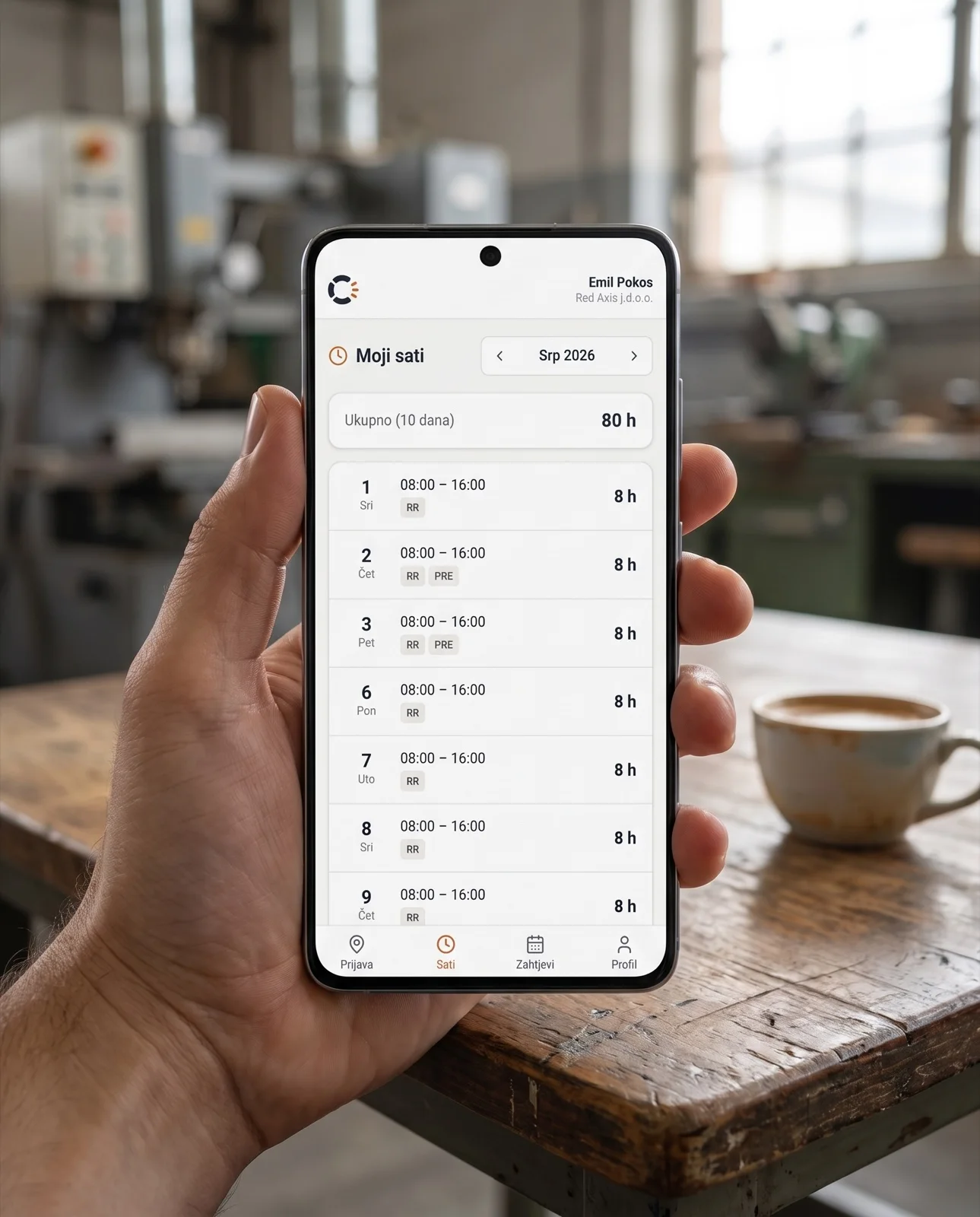
The solution is not a prettier spreadsheet, but a record created at the entrance, at the moment of clock-in, by card, PIN or QR. Time is logged automatically, pay premiums are calculated on their own, absences are categorised, and the report for the inspection is exported as a PDF under Article 13. The same system works in the plant and on the construction site, so there is no more re-copying from five sources. See what it looks like for the plant and production or check the pricing.
Related: What records must contain under NN 55/2024 and Penalties for improper records.
Replace the spreadsheet with a record created at the entrance.
Exact time, an audit trail, automatic pay premiums and a PDF for the inspection. Start on a device you already have.